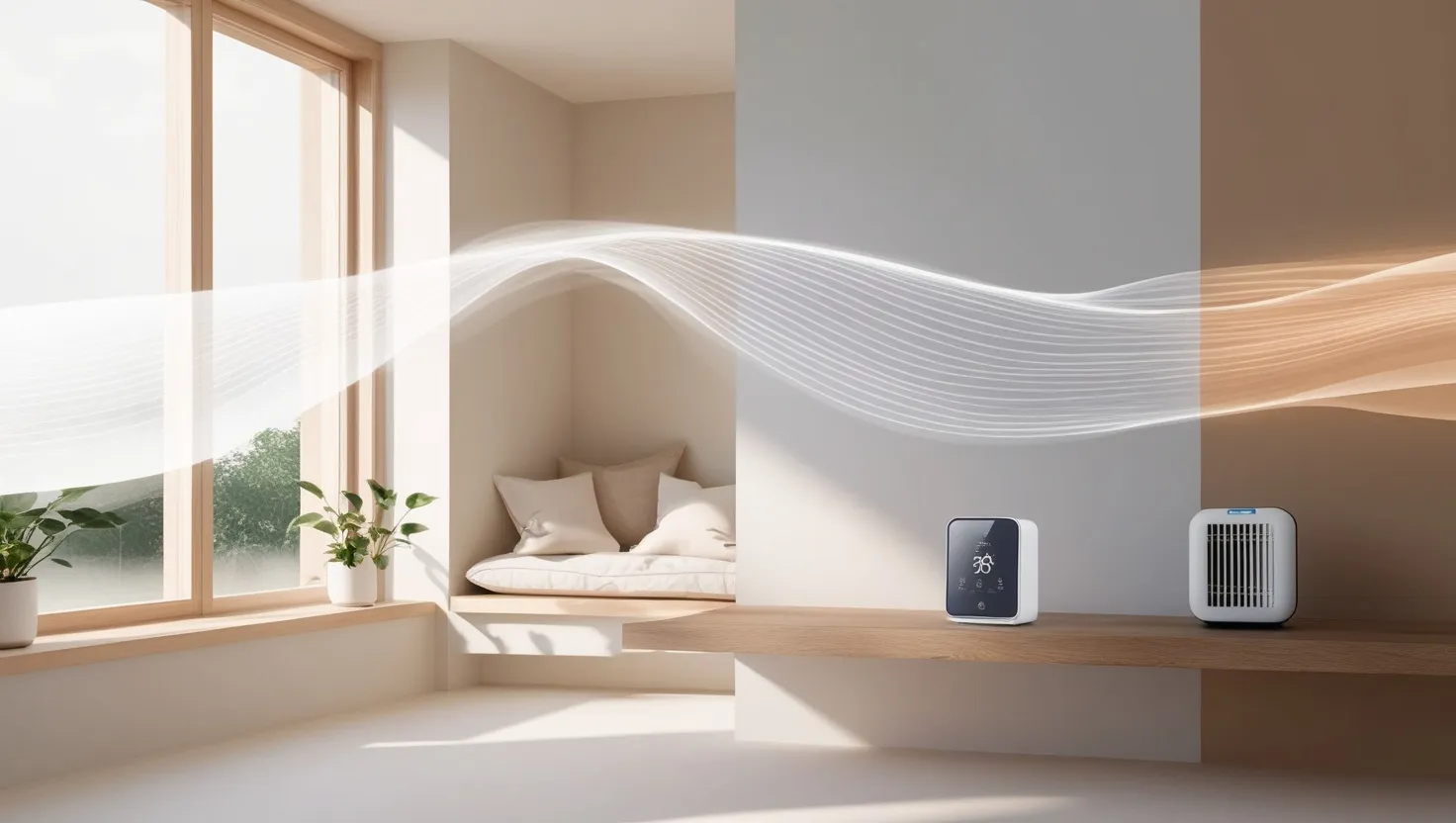
Your home breathes, whether you notice it or not. The air moving through your rooms right now carries invisible signals that reach your brain faster than any cup of coffee ever could. Most people treat their thermostat like a blunt instrument, only touching it when they feel too hot or too cold. That is a mistake. Temperature, humidity, and air quality are not background noise. They are tools, and once you start using them on purpose, your days feel different.
Let me start with temperature zoning, because this one surprises people the most. A room sitting at 68 degrees keeps your mind alert and focused during work that demands concentration. A room at 74 degrees does the opposite, inviting your body to slow down and your conversations to flow easier. Instead of fighting one temperature across your whole home, why not create pockets? Smart vents and portable units can hold different zones at different settings. Program them to shift as you move from your desk to your couch, so the room adjusts to your intention before you even notice you needed it.
As Mark Twain once said, “Climate is what we expect, weather is what we get.” Your home does not have to leave things to chance the way the sky does.
Humidity is the next piece, and it gets ignored more than it should. Keeping relative humidity between 40 and 60 percent supports easy breathing and clear thinking. Drop below 30 percent and your airways dry out, your focus dulls, and you might not even connect the dots. Push past 65 percent and the air turns heavy, inviting mold you cannot see until it is a problem. A smart humidifier or dehumidifier that reads live sensor data can hold this balance without you lifting a finger. You wake up with a clearer head. You sleep through the night instead of tossing at 3 a.m. wondering why your throat feels like sandpaper.
Have you ever sat in a meeting room and felt your eyelids grow heavy for no reason? That is probably carbon dioxide working against you. In a closed room, CO2 can climb past 1000 parts per million within an hour, and once it does, your brain slows down and your decisions get worse. A simple monitor connected to a ventilation system or a smart window can flush the stale air before you even notice the drowsiness creeping in. Schedule a flush right before you sit down to write, or right after you finish cooking dinner. The change in how sharp you feel is not subtle. It is measurable within minutes.
Rachel Carson wrote, “In nature nothing exists alone.” The same is true inside your walls. Every particle in your air interacts with your body, your mood, and your ability to think clearly.
Speaking of particles, cooking, cleaning, and even the air drifting in from outside all leave behind fine particles and chemical vapors that quietly wear down your lungs and your focus. A smart purifier with HEPA and carbon filters can run on schedule or react the moment sensors detect a spike. Connect it to your stove hood, and it kicks in the second you sear something on high heat. Connect it to a motion sensor in the kitchen, and it responds when you reach for the ammonia spray. Your lungs get protection you never have to think about.
What if the answer is not adjusting the whole room, but only the air around your body? A heated desk pad can keep your hands warm without heating your entire office. A small neck fan can cool your face in the middle of a stressful call, no need to touch the thermostat at all. Wearable sensors are getting smart enough to nudge you toward a cool drink or a short walk into fresh air before you even feel uncomfortable. These small, targeted moves give you control that a single room-wide setting never could.
Antoine de Saint-Exupéry once wrote, “Perfection is achieved, not when there is nothing more to add, but when there is nothing left to take away.” Microclimate design works the same way. You are not adding more machines and more noise to your life. You are removing the guesswork, the discomfort, and the wasted energy that comes from ignoring what your air is doing to you.
Think about how much of your day happens indoors. Work, meals, sleep, rest, most of it unfolds inside four walls where the air rarely gets a second thought. Now think about how much better a single afternoon feels when the temperature is right, the humidity is balanced, and the air is clean. You already know the feeling. The question is whether you want to leave it to chance or build it on purpose.
Setting this up does take a little effort at first. You will need sensors that read temperature, humidity, and CO2 in real time. You will need smart vents, a purifier, maybe a humidifier or two, and some way to tie them together so they respond automatically. But once the system is running, it asks nothing more from you. You define your ideal parameters once, and the environment holds them steady without another thought from you.
Isn’t it strange how much money we spend on productivity apps, planners, and coffee, while the air we breathe all day gets almost no attention at all? Henry David Thoreau once wrote, “The mass of men lead lives of quiet desperation.” Maybe part of that quiet desperation comes from environments working against us instead of for us, and we never even notice because we assume discomfort is just how a room feels.
Try this for one week. Pick one zone in your home, maybe your workspace, and set the temperature to 68 degrees during work hours. Add a humidity monitor and keep it between 40 and 60 percent. Track how you feel at the end of each day. You do not need to overhaul your whole house to notice a difference. Small, deliberate changes in one room can show you what is possible everywhere else.
The bigger idea here is simple: comfort is not something that happens to you, it’s something you can design. Air, temperature, and humidity are not fixed facts of a room. They are variables, and variables can be tuned. Once you start treating your home this way, you stop reacting to discomfort and start preventing it before it even shows up.
A sharper mind, steadier energy, and a body that is not fighting its environment all day, that is what is waiting on the other side of a few sensors and some thoughtful programming. Your home can either work against you in silence or support you without you noticing. The choice, and the setup, is entirely yours.