Most of us walk through our homes the same way we walk through a busy street — heads down, distracted, moving from one task to the next. The kitchen is for cooking. The desk is for working. The bedroom is for sleeping. Every surface has a job, and every room is measured by its usefulness. But what if a corner of your home could hold something more than function? What if a small, forgotten ledge could become the most meaningful square foot in your entire day?
That’s the idea behind micro-sacred spaces. And no, you don’t need a meditation room or a spare bedroom or a Zen garden in the backyard. You need a few inches of intention.
“Your sacred space is where you can find yourself again and again.” — Joseph Campbell
Let’s be clear about what “sacred” means here. It doesn’t have to be religious. It doesn’t require candles or incense or anything you’d find in a spiritual shop. Sacred simply means set apart. Deliberately different from the rest. A thing — or a space — you’ve decided to treat with more care than the ordinary.
Think about the places in your life where you automatically slow down. A park bench you always stop at. A specific chair by a window you gravitate toward on hard mornings. You didn’t design those moments on purpose, but they happened anyway. Now imagine building that effect intentionally, inside your own home, in spaces you already have.
Have you ever noticed how the same room can feel completely different depending on where you’re standing in it?
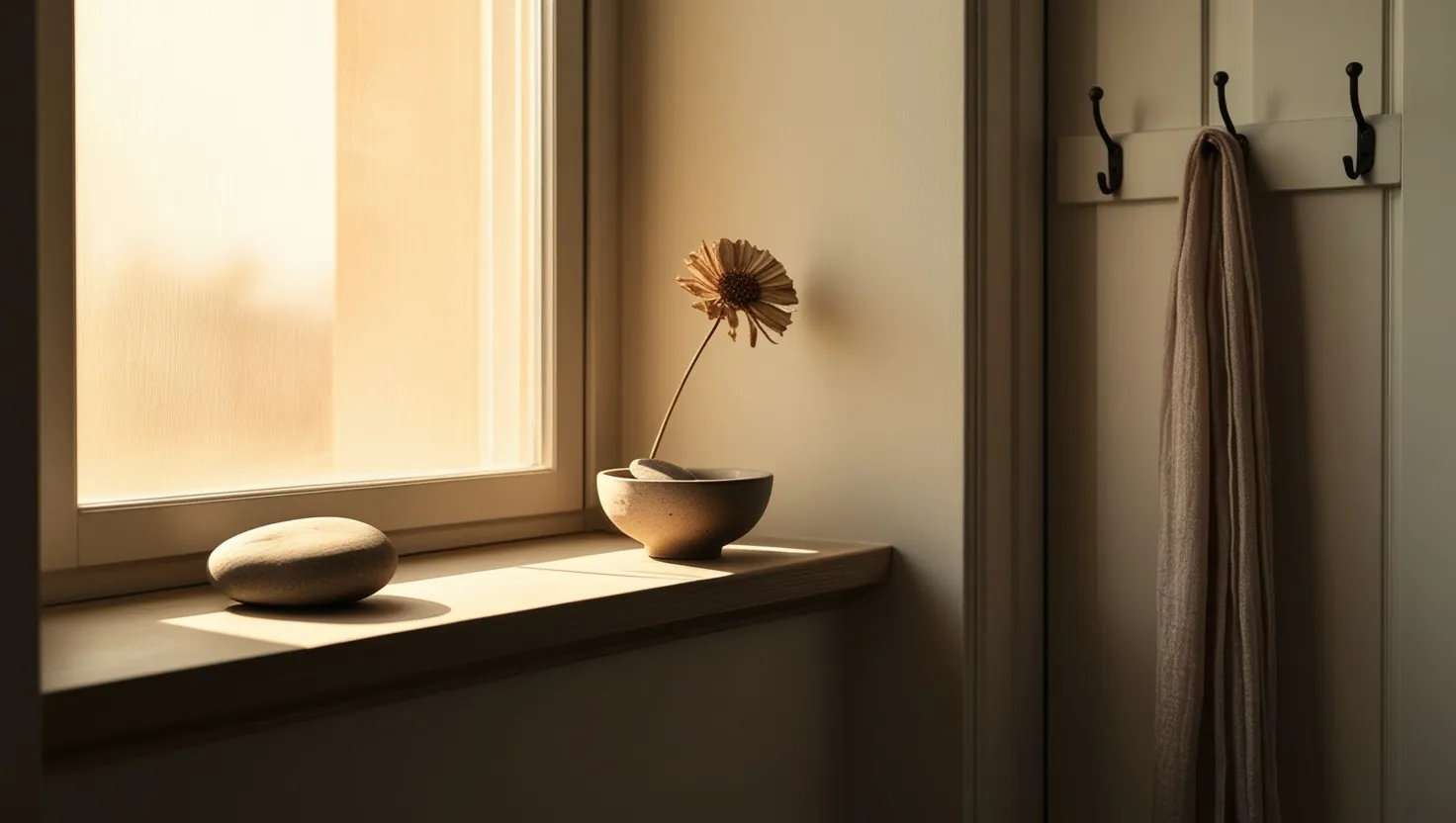
Start with light. Find one spot in your home that receives natural light at a consistent time each day. This is easier than you think — a window ledge, a kitchen sill, the corner of a desk near a south-facing window. Place a single object there that needs zero maintenance. A smooth river stone. A dried flower head. A small ceramic figurine. Something that asks nothing of you except a glance.
Visit that spot at the same time each day for no more than ninety seconds. Don’t make it a project. Don’t journal about it. Just stand there, look at the object, breathe once or twice, and leave. That’s it. What happens over weeks is quiet and almost invisible: the spot begins to carry weight. Your nervous system starts to associate that corner with pause, and the pause starts to feel necessary. The object becomes a fixed star in your daily orbit.
This is backed by something older than psychology. Ancient Romans kept a lararium — a small household shrine near the entrance of a home — not for grand worship but for daily acknowledgment. A brief gesture toward the family gods each morning. The ritual wasn’t elaborate. The meaning was.
Now think about your front door. Most people treat it like a loading dock. Keys land there. Bags pile up. Shoes accumulate. But your front door is actually the most psychologically loaded threshold in your life. You cross it twice a day, once leaving and once returning. That crossing is a transition — and transitions are where the mind is most open to suggestion.
Designate a single hook or small shelf near that door for one object that represents the kind of day you want to have. Not your keys. Not your bag. One symbolic object chosen each morning. A bright scarf for energy. A small bell for mental clarity. A pressed leaf for the kind of calm you’re aiming for. Each morning you hang it. Each evening you remove it and ask yourself, honestly, whether you managed to live that intention. You don’t grade yourself. You just notice.
“We are what we repeatedly do. Excellence, then, is not an act but a habit.” — Will Durant, paraphrasing Aristotle
The hook holds a daily promise. That’s all. But promises, even private ones made to yourself, carry surprising weight when repeated.
Here’s a question worth sitting with: how many parts of your life exist only in your head, with no physical anchor in your space?
Most people carry their long-term aspirations, their half-formed plans, their sentimental memories purely as mental weight. No object, no place, nothing tangible to visit. This is why a drawer — an ordinary, low-traffic drawer — can become something remarkable.
Pick a drawer in a quiet room. A guest bedroom, a study, a hallway console. Line it simply. Populate it with three objects that represent things you rarely think about but care about deeply. A map of somewhere you’ve always wanted to go. A letter from a friend who lives far away. A small instrument you bought with the best of intentions. Once a week, open that drawer. Not to do anything. Just to open it and look. The act of opening reconnects you to the parts of your life that daily routine buries under scheduling and obligation. The drawer becomes a reservoir. You dip in, you remember who you are beyond your to-do list, and you close it again.
Sound is the most underused tool in personal ritual design, and the bathroom is the most underused room for intentional living.
Pick a single piece of music — three minutes long, no more — and play it only during your morning preparation. Classical guitar. A field recording of a forest after rain. A slow jazz instrumental that feels like early light. This piece plays nowhere else in your life. Only here, only now, only during this transition from sleep to action. Within a few weeks, those opening bars will shift your body before your mind has even caught up. The music becomes a signal. The bathroom mirror becomes a stage for a private daily concert, and the concert tells your nervous system: we are moving now, with intention, not just inertia.
“Music gives a soul to the universe, wings to the mind, flight to the imagination, and life to everything.” — Plato
What about the small obligations that float through your life without resolution? The library card you need to return. The thank-you note you’ve been meaning to write. The repair receipt sitting somewhere in a pile. These things are not urgent enough to act on immediately, but they nag. They create a low-grade hum of incompletion.
Place a small tray or bowl in your living area — something beautiful enough that you don’t mind looking at it — and make it the single holding space for these small, pending things. This is not a to-do list. A to-do list pressures. This tray simply holds. Each time you pass, you see what’s there. You acknowledge it. You greet it the way you’d nod at a neighbor you’ll speak to properly later. When you finally act, you move the object to its rightful place, and the tray lightens. The tray doesn’t accuse you of procrastination. It just waits, patiently, like a good assistant.
The Japanese concept of ma — often translated as “negative space” or “pause” — describes the gap between things as having as much meaning as the things themselves. A rest in music. A silence between sentences. The empty moment before a door opens. Micro-sacred spaces are, in a sense, ma built into the architecture of daily life. They are the pauses you build into the long sentence of your day.
“In the middle of difficulty lies opportunity.” — Albert Einstein
Ask yourself this: if your home could speak about who you are, what would it say right now?
For most people, it would say something about productivity, storage, and convenience. It would say very little about intention, memory, or meaning. That gap — between the home as machine and the home as witness — is exactly where micro-sacred spaces live.
They cost almost nothing. A stone. A drawer. A hook. A playlist. A tray. The investment is not financial. The investment is attention, which is the rarest currency most of us have.
Your home already contains these spaces. The window ledge is already there. The drawer exists. The hook by the door has been waiting. All that’s missing is the decision to treat them as more than functional — to assign them a different kind of job. Not storage. Not convenience. Meaning.
Start with one. Pick the spot that already feels slightly different when you stand in it. The place where you naturally pause, even if only for a second. That pause is already sacred. You just haven’t claimed it yet.