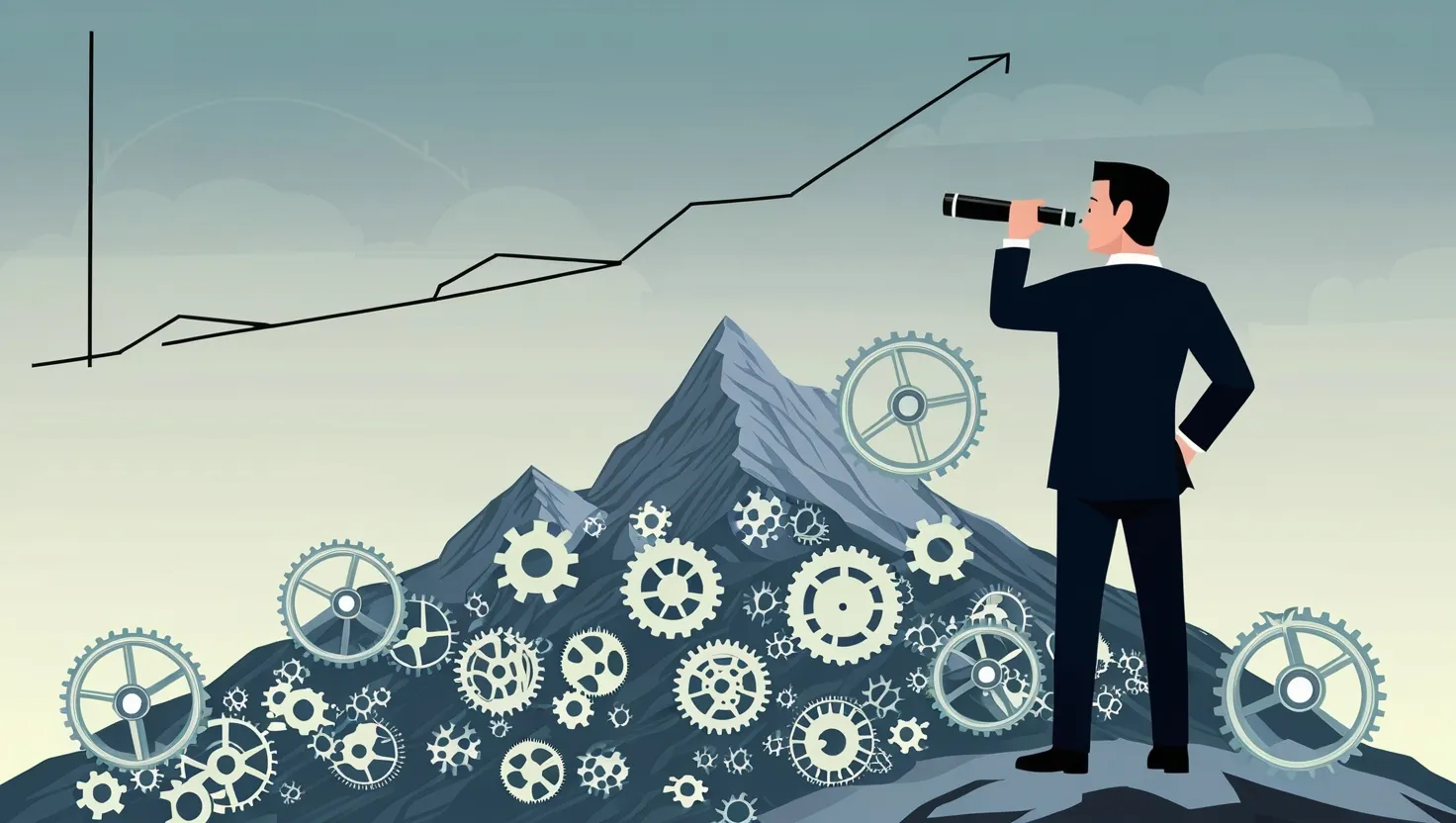
How to Find Gold in Falling Industries: A Value Investor’s Guide to Technology Disruption
When an industry faces technological disruption, most investors panic and sell. But here’s what many people miss: panic creates opportunity. Think of it this way. When everyone runs toward the exit at the same time, the smartest investors are walking in the opposite direction, looking for something others have abandoned too quickly.
I’ve spent time studying how technology reshapes industries, and what I’ve learned is simple. The market is terrible at nuance. It sees disruption and assumes total destruction. But the real world is messier. Some companies genuinely deserve to disappear. Others just need time to adapt. Knowing the difference separates exceptional investors from those who lose money trying to catch falling knives.
The fundamental insight here is that technological disruption creates what I call a “pessimism discount.” When anxiety peaks, prices fall not just for weak companies but also for strong ones caught in the wrong industry at the wrong moment. This is where patient, analytical investors find their best returns.
When Disruption Doesn’t Mean Death
Let me start by explaining something most people get wrong. Disruption doesn’t automatically destroy value. It redistributes it. A fax machine company was disrupted by email, yes, but that doesn’t mean every employee at that company should have expected bankruptcy. Some adapted. Some pivoted their manufacturing expertise toward new industries. Others were absorbed by larger competitors at reasonable valuations.
The key question isn’t whether an industry will change. It will. The question is whether the specific company you’re analyzing will survive that change. This distinction matters enormously because it’s where most investors fail. They see industry disruption and mentally delete entire companies from existence without actually studying them.
Here’s what I look for first. Does this company have what business people call a “moat”? A moat is simply something that protects the business from competitors. It could be a brand so strong that customers trust it even in new formats. Think about how CNN maintained influence even as cable news declined because people recognized the brand. It could be customer relationships so deep that switching costs are high. Or it could be a distribution network so extensive that new competitors would spend years and billions trying to replicate it.
Some moats are industry-specific and truly vulnerable to disruption. But many are more durable than they appear. A luxury fashion brand built over fifty years doesn’t lose its value just because retail shifted online. The brand probably becomes more valuable because it’s proven to survive transitions. This is counterintuitive, but it’s true.
The Art of Watching Management Handle Crisis
This is where most investors miss something crucial. When disruption hits, what does the company’s leadership do? There are basically three responses. Some leaders deny the problem and pretend it will go away. Some leaders panic and slash everything, destroying long-term value in pursuit of short-term survival. The best leaders acknowledge the threat, assess it honestly, and make deliberate investments in adaptation.
I pay close attention to allocation of capital during disruption. A company that steadily invests in new capabilities while maintaining its existing business usually survives and thrives. A company that burns through cash on ill-conceived “digital transformation” initiatives without clear strategy is probably deteriorating. And a company that ignores disruption entirely is almost certainly a value trap.
How do you spot the difference? Read what management actually says, not what Wall Street wants them to say. Do they acknowledge specific competitive threats, or do they speak in vague corporate speak about “innovation”? Do they explain their investment plans with measurable goals, or do they offer generic promises? Do they admit to failures and show how they’re learning, or do they project false confidence?
The company that says “We invested $50 million in our digital platform and we’ll know by Q3 whether it’s working because we’re measuring these three metrics” is probably being run by someone serious. The company that says “We’re excited about our digital transformation” is probably in trouble.
Separating Temporary Pain from Terminal Decline
Here’s a practical problem that trips up most investors. When a company reports bad results, is that because of disruption or because of something else? This matters enormously. If a company is struggling purely because the broader economy is weak, that’s temporary. If it’s struggling because technology is making its core product obsolete, that’s permanent.
I look at what’s actually happening to the numbers. Is revenue falling because customers are disappearing or because prices are compressed? Those have different implications. If a traditional retailer’s sales are down thirty percent but foot traffic is stable and average transaction size is intact, that suggests operational challenges rather than market destruction. But if foot traffic is collapsing, that’s different. That’s real disruption.
Here’s something most people overlook. Many companies facing disruption experience what looks like a cyclical downturn before the structural problem becomes obvious. During recessions, consumer spending drops. During tech cycles, investment shifts. These temporary pressures often coincide with genuine disruption, creating confusion. The market prices these companies as if they’re dying when they’re actually just struggling through a rough cycle.
I try to isolate variables. What would this company’s financial performance be if the economy was healthy? What would it be if the technology hadn’t changed? By answering those questions separately, I can see what’s really happening.
Finding Hidden Value in Forgotten Assets
This is where I’ve found some of my best ideas. Legacy companies often own assets that seem worthless in their current business but become incredibly valuable in a new context. These assets sit on balance sheets at low carrying values because nobody has figured out what to do with them yet.
A traditional broadcaster, for example, owns local news operations in hundreds of markets. When streaming disruption hit, investors assumed the entire business was doomed. But I looked at what the company actually owned. It owned relationships with local businesses, trust in local communities, and infrastructure that could produce video content more cheaply than most competitors. Those assets weren’t worthless. They just needed to be deployed differently.
Similarly, a commercial photography business facing disruption from digital cameras and smartphones actually owned real estate, equipment, and customer relationships that could be valuable in a new context. Instead of taking traditional photographs, they could pivot toward visual content production, event management, or technology services. The assets didn’t disappear. They just needed redeployment.
Where does this lead in practical terms? Look at the balance sheet differently. What is this company actually worth if you liquidated just its tangible assets? Land, buildings, equipment, inventory. What are those worth in a fair market sale? If a company’s stock price is below that number, you have a safety net. Even if the adaptation fails completely, you’re not paying a premium for terminal decline.
“The three most important words in investing are ‘margin of safety.’” — Warren Buffett
Building Multiple Scenarios for Your Investment
When I’m analyzing a disrupted company, I don’t build one valuation model. I build several. What if the company adapts successfully and captures fifty percent of its original market? What if it only captures twenty-five percent? What if it takes ten years instead of three years?
For each scenario, I calculate what the stock should be worth. Then I assign a probability to each scenario based on everything I know about the company’s management, assets, competitive position, and market dynamics. This gives me a range of possible outcomes rather than a false sense of precision.
The key is that I’m looking for situations where even my pessimistic scenario suggests the stock is undervalued. If the company is trading at a price that only makes sense if my worst-case scenario happens, I have significant margin of safety. The market is pricing in failure. But I’ve done enough analysis to know failure isn’t the most likely outcome.
This is different from being optimistic. I’m not betting on a miraculous recovery. I’m betting that the market’s pessimism has become detached from reality.
Practical Metrics That Actually Matter
When I’m deciding whether to invest in a disrupted company, I track specific metrics that tell me whether adaptation is actually happening. Revenue growth in new business lines matters enormously. If management claims they’re adapting but new revenue is flat, that’s a red flag. Track it quarter to quarter. Is it growing?
Customer retention across different product categories tells me whether brand loyalty is real or illusory. If customers who tried the old product are moving to the new product, that’s positive. If they’re leaving for competitors, that’s negative. This sounds obvious until you realize most investors don’t actually look at this data.
Research and development spending efficiency is another crucial metric. How much are they spending on new capabilities compared to pure-play disrupting competitors? If they’re matching the spending but generating better returns, their existing business is helping them innovate. If they’re spending more and getting worse results, that’s concerning.
Gross margin trends matter significantly. If margins are falling because the entire industry is under pressure but remaining relatively stable within that context, that’s manageable. If margins are collapsing specifically for this company, that suggests competitive deterioration beyond general disruption.
“It’s far better to buy a wonderful company at a fair price than a fair company at a wonderful price.” — Charlie Munger
Real Examples From Real Markets
Let me walk through an actual situation I studied. A major payments processor was genuinely disrupted by fintech startups. Stock fell sixty percent from its peak. Everyone said it was over. But I looked deeper. The company processed payments across thousands of merchant locations. Switching that infrastructure would cost enormous amounts of money and create operational risk for customers. That infrastructure was a moat.
The company’s management recognized the threat and began integrating new payment technologies into their platform. They started acquiring smaller fintech companies to learn faster. They adjusted their fee structure to remain competitive. Were they perfect? No. But they were adapting systematically.
I calculated scenarios. Even if they lost fifty percent of their existing business but captured twenty percent of the new payments market, their cash flows would be healthy. They were trading as if they’d lose ninety percent of everything. I bought at that price. Three years later, the company had stabilized with a healthy mix of traditional and digital payments. The stock doubled. It wasn’t a home run. But it was a solid return from a company everyone thought was dead.
Another example involved a traditional broadcaster that faced genuine cord-cutting disruption. But the company owned local news operations that built deep community trust. When streaming became dominant, this company was well-positioned to offer local content that competitors couldn’t easily replicate. Management made deliberate investments in digital distribution. Again, they weren’t perfect. But they adapted. And the market’s despair created buying opportunity.
The Patience Premium You’re Paid For Waiting
Here’s something most investors won’t admit. This kind of investing is boring. You buy a stock that everyone hates. You hold it. Maybe it doesn’t move for two years. Maybe it moves down before it moves up. Meanwhile, growth stock investors are buying exciting companies with exciting stories. They’re right sometimes. But when they’re wrong, they can lose everything. When I’m wrong, I’m usually protected by margin of safety.
The returns from disrupted value situations aren’t usually spectacular. They’re steady. You buy something trading at six times cash flow when the business is genuinely valuable. Over five years, cash flow grows back to normal levels. The valuation multiple normalizes. Suddenly what was a disappointing stock becomes a reasonable investment.
But here’s the thing. If you’re disciplined and patient, those reasonable investments compound. You make them repeatedly. You avoid the disasters. And over a career, that discipline produces exceptional results. Ask the investors who bought during crisis moments. The returns weren’t always immediate. But they were real.
Your Decision Framework
So when you’re evaluating a company facing technological disruption, here’s what I want you to ask. First, is the core moat genuinely eroding or is it evolving? Does this company have something that will matter in the new technology landscape? Second, how is management responding? Are they adapting thoughtfully or denying reality? Third, what are the hidden assets? What does this company own that might be valuable in a different context? Fourth, what’s my margin of safety? If my pessimistic scenario happens, am I still okay? Fifth, what specific metrics tell me whether adaptation is working?
Answer those questions honestly, and you’ll find yourself making better investment decisions. You won’t catch every opportunity. You’ll probably miss some returns. But you’ll avoid many disasters and capture some exceptional situations where fear has overwhelmed facts. In the long run, that’s how disciplined investing creates wealth.