Most people think debt is just about numbers. I want you to see it as a simple, clear plan you can control, even if you feel “bad with money” or totally lost right now.
Let’s walk through five methods to pay down high‑interest debt in a way that is strategic but still easy enough for anyone to follow. I’ll keep language simple, use real-world logic, and speak to you like I would to a friend who feels stuck and tired of watching their money vanish into interest.
“The man who never has money enough to pay his debts has too much of something else.”
— James Lendall Basford
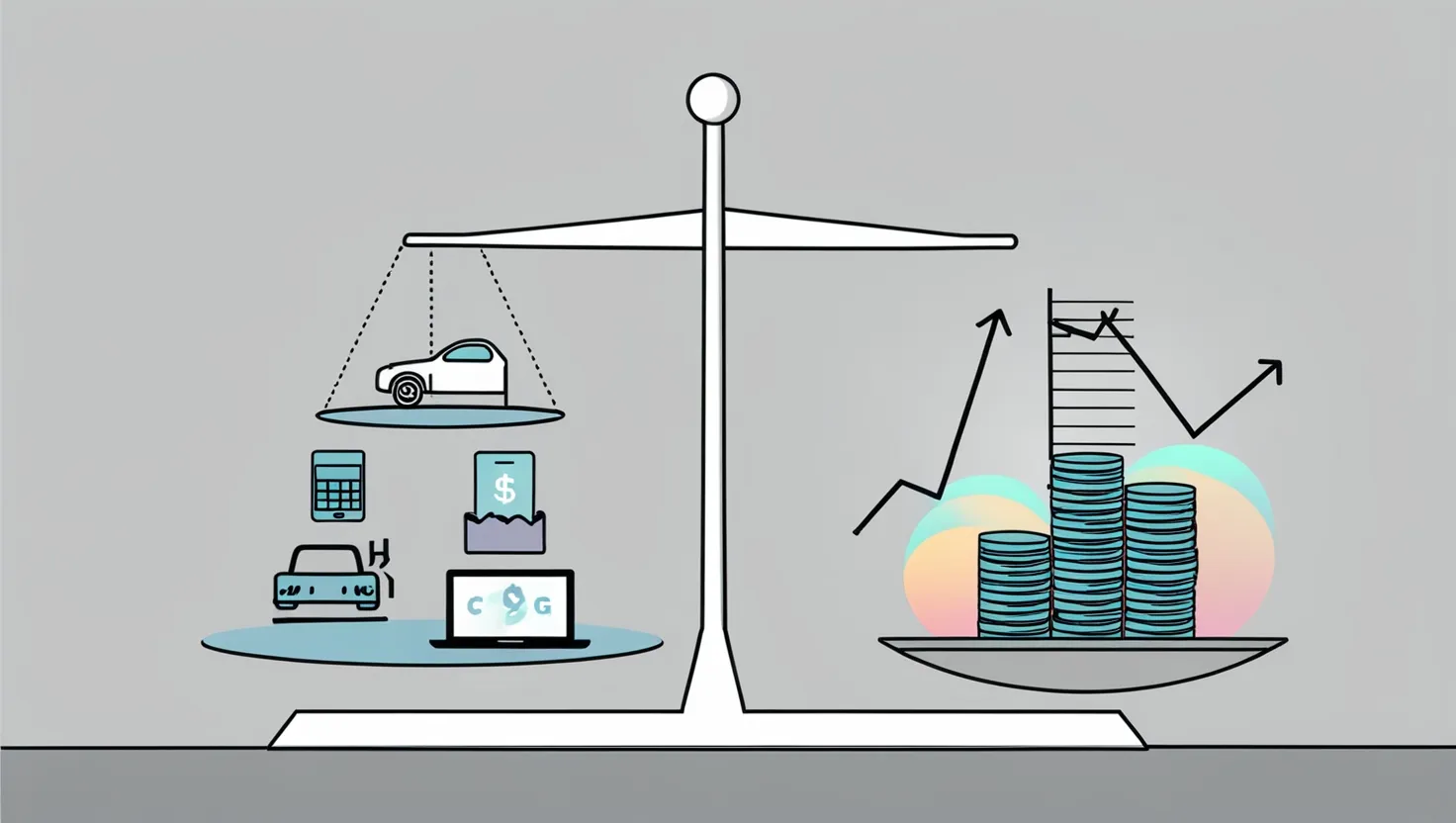
First, I want you to think of your debt like a map, not a monster. Right now you might just see “a big scary number.” But that big number is made up of smaller pieces, each with its own interest rate, balance, and minimum payment. If you do not break it down, your brain will keep telling you, “This is too much,” and you will feel frozen.
So I’m going to start with something that sounds boring but is the base of everything: a complete debt list.
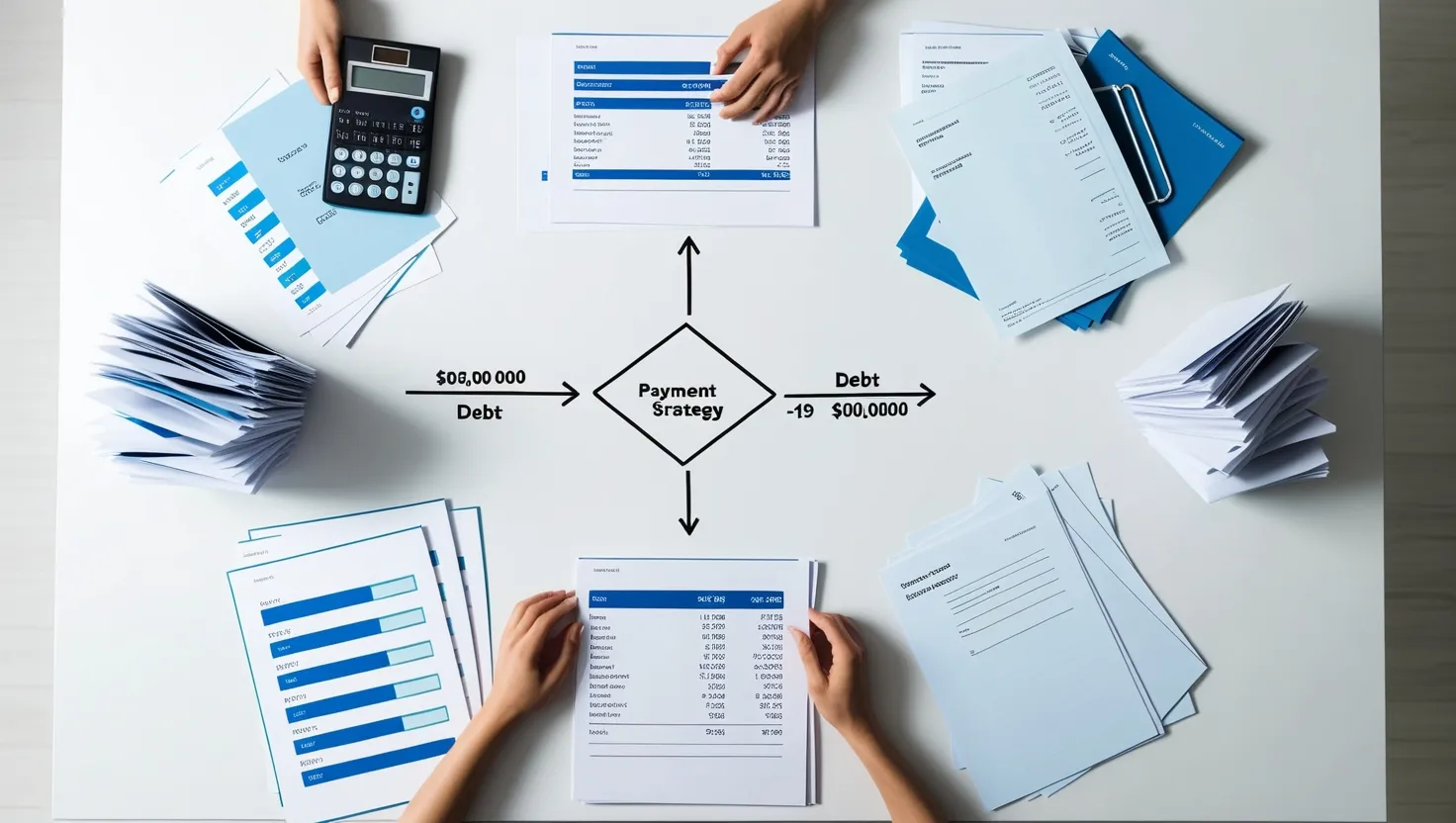
You sit down and list every single high‑interest debt. Credit cards. Store cards. Buy-now-pay-later accounts. Personal loans with high rates. For each one, write four things: name of lender, balance, interest rate, and minimum payment. No guessing. No “rough idea.” Exact numbers.
Then you copy that list twice.
In one version, you sort from smallest balance to largest balance.
In the other version, you sort from highest interest rate to lowest interest rate.
Why two lists? Because you are not just fighting math. You are also fighting feelings, habits, and stress. One list gives you psychological fuel. The other gives you mathematical efficiency. You will pick a method that fits you, not someone else’s personality.
Let me ask you something: are you the kind of person who needs quick wins to stay on track? Or are you okay with slow progress as long as you know it saves you more money over time?
That simple question will help you choose between Method 1 and Method 2.
“Beware of little expenses; a small leak will sink a great ship.”
— Benjamin Franklin
Method 1: The debt avalanche – for maximum interest savings
With the avalanche method, you act like a laser. You pay minimums on everything, and you put every extra dollar you can find onto the debt with the highest interest rate.
So if one card is at 28%, another at 22%, and another at 17%, you hit the 28% card first, even if it has the largest balance.
Why? Because high interest is like a leak in your wallet. The higher the rate, the faster your money drains away. When you attack the highest rate, you plug the worst leak first. That means, over time, you pay less total interest.
When that first high-rate debt is gone, you do something powerful: you do not relax. You do not lower your total payments. You take the whole amount you were paying on that card and add it to the payment on the next highest-rate card. You keep the total amount you send to debt every month the same or higher.
It’s like building a payment “machine” that gets heavier each time a debt disappears.
Many people make a mistake here: as soon as one card is paid off, they say, “Nice, an extra $150 a month to spend.” That’s how debt cycles keep repeating. I want you to say instead, “Nice, an extra $150 to throw at the next card.”
If you care most about saving money in interest and reaching financial freedom faster overall, this is usually the best method. Think of it as the “nerd method”: maybe less emotional, but very efficient.
Method 2: The debt snowball – for people who need quick wins
Now, what if you are the kind of person who starts things and loses steam quickly? Gym in January. New diet. Online course. You begin excited, then life gets in the way.
Debt payoff is no different. If that sounds like you, the snowball method may fit better.
With the snowball, you again pay minimums on every debt. But this time, you aim all extra money at the smallest balance, not the highest interest rate.
Why would anyone do that if it is not the most efficient mathematically?
Because your brain loves completed tasks. Paying off a $400 card completely feels huge mentally, even if there’s a bigger debt at a higher rate. That “I actually finished something” feeling is not just emotional fluff. It builds identity. You go from “I’m bad with money” to “I am someone who pays things off.”
That identity shift matters more than most people realize.
After you kill that smallest debt, you roll its payment onto the next smallest debt. So if you were paying $30 minimum on the first one and $50 on the next one, once the $30 card is gone, you now pay $80 on the second card. Your “snowball” grows.
Is the snowball always the cheapest in interest? No. But for many people, it is the only method they will actually stick to. A sub‑optimal plan you follow fully is better than a perfect plan you abandon.
So I’ll ask you again: would you quit if progress feels slow? If yes, the snowball could be your best friend.
“Success is the sum of small efforts, repeated day in and day out.”
— Robert Collier
Method 3: Negotiating with creditors – quiet money you can save in one phone call
Now we move to a method almost everyone ignores: negotiation.
Many people think interest rates are fixed, like the weather. They are not. Lenders care about two big things: getting paid and not losing you to a competitor.
If you have paid on time for a while, you have more power than you think.
I suggest you do this: pick one card, call the number on the back, and say something simple like:
“I’ve been a customer for X years and I’ve been making my payments. My interest rate is X%. I’ve received offers for lower rates from other companies. Can you reduce my rate so I can keep my account here and pay this off faster?”
You do not need fancy words. You just need to ask calmly and clearly.
They might say no. But many times, they will say yes, or they will offer a temporary lower rate. Even a small drop can matter. For example, cutting a rate from 24% to 18% on a large balance can save you hundreds of dollars in interest over a normal payoff period.
That is “invisible progress.” Your monthly payment might stay the same, but more of it goes toward the actual balance instead of interest.
You can also ask if they have a hardship program. This is not only for people who are completely broke. Sometimes they can reduce your rate or fix your payment for a set time while you get back on your feet.
Let me ask: have you ever been scared to call because you feel ashamed or worried they will judge you?
Remember this: the person on the phone talks to people in debt all day. You are not special in your situation. That is good news. It means you are normal, and they have systems that might help.
“It’s not your salary that makes you rich, it’s your spending habits.”
— Charles A. Jaffe
Method 4: The temporary spending freeze – a focused sprint
Now we talk about speed.
If you want to cut years off your debt payoff, you need a period of intense focus. Not forever. Just for a short time.
I call this a temporary spending freeze on non‑essentials.
For 60–90 days, you and I agree that anything that is not needed for survival or basic work life is “on pause.” This might mean:
No eating out.
No new clothes unless truly necessary.
Cancel or pause extra subscriptions.
Cheaper phone plan if possible.
Lower-cost entertainment: library, free events, at‑home movie nights.
Here is the key: you do not just “spend less.” You redirect every freed‑up dollar to your chosen debt method (avalanche or snowball). Being cheap alone will not change much if the money has no new job.
Also, write clearly that this is temporary. Your brain can tolerate almost any sacrifice if it knows there is an end date. You are not saying, “I will never enjoy my life again.” You are saying, “For the next 3 months, I am sprinting so my future life is lighter.”
Ask yourself: if you went “hard mode” on your spending for just 90 days, how much extra could you find? $200 per month? $400? Even $100 extra can take months off a debt.
You can even make it a challenge: stick a simple tracker on your wall. Each week you hit your extra payment goal, you color a box. Simple visuals can keep you going when nobody around you understands what you are doing.
“You must gain control over your money or the lack of it will forever control you.”
— Dave Ramsey
Method 5: Restructuring your cash flow – automate like you do not trust yourself
Most people try to pay debt with willpower. That works for a week or two. Then a rough day at work hits, or a birthday, or a sale, and the extra money “disappears.”
Instead of trusting your future self to “do the right thing,” set up systems that do the right thing automatically.
Here is a simple pattern:
On payday, before you see the money as “yours to spend,” have automatic transfers set up:
- minimum payments scheduled on all debts
- extra payment to your current target debt scheduled right after payday
When the money never sits in your checking account looking tempting, you are far less likely to use it.
Another structural move: line up due dates. If you can, call your card companies and move due dates closer to your paydays. That way, your payments happen when money is fresh, not when your account is empty and you are stressed.
You can also set a small buffer category in your budget labeled “life happens.” This is not for fun; it’s for minor surprises, like a small car repair or a prescription. That buffer keeps you from running back to the card the moment something goes wrong.
Let me ask you: if no extra payments were left up to “remembering” or “feeling motivated,” how much more likely is it that this plan would work?
Automation is like putting your money on rails. You design the tracks once. Then you just watch the train move.
“The secret of getting ahead is getting started. The secret of getting started is breaking your complex overwhelming tasks into small manageable tasks, and then starting on the first one.”
— Mark Twain
Putting it all together with simple numbers
Let’s keep the math easy to picture.
Say you have $15,000 in credit card debt at about 20% interest. If you just pay $400 a month and do nothing special, you could be stuck for more than 5 years and pay around $10,000 in interest over that time.
Now imagine you:
- call and get some rates lowered
- choose the avalanche or snowball method and stick to one
- do a 3‑month spending freeze and find an extra $200 a month
- automate payments so the $600 total goes out right after payday
With $600 going out instead of $400, and some lower rates from negotiation, your payoff time can drop to under 3 years, and your total interest can fall by thousands of dollars. That is money you can later use for savings and investing, not sending to banks.
Does that sound like a dream right now? That is okay. Big change always feels unreal at first. But every part of that plan is a simple step you can do in a normal life.
The emotional side nobody talks about
Numbers matter, but feelings drive most financial choices.
High‑interest debt often comes with shame. Many people tell themselves, “I’m stupid,” “I ruined everything,” or “It’s too late.” These thoughts do more damage than interest rates, because they make you stop trying.
I want you to think of your past debt decisions as data, not moral failure. The debt exists. That is all. Now you are building a plan. That makes you responsible, not hopeless.
When you pay off one card, no matter how small, I want you to actually celebrate it. Say it out loud: “I closed a chapter.” You are training your brain to connect “progress with effort,” not “pain with money.”
If you live with someone else and share money, talk openly about the plan. Blaming kills teamwork. You can say, “Here’s our map. Here’s the order. Here’s what we are freezing for 3 months. Here’s what we’ll do to reward ourselves later.” Keep it simple and specific.
Your next three steps from here
To keep this practical, I will finish by telling you exactly what I would do in your shoes, today:
-
Sit down and create the full debt list with balances, interest rates, and minimums. Make the two versions: sorted by rate and sorted by balance.
-
Decide: avalanche or snowball. Ask yourself honestly, “Do I need fast wins more, or do I care most about paying the lowest interest?”
-
Pick up the phone and call one card company about a lower rate. Not all of them. Just one. Get a small win and see that it is possible.
From there, you can plan a 60–90 day spending freeze and set up automatic payments.
Money may have felt like chaos up to now. But with five simple methods—debt avalanche, debt snowball, negotiation, temporary spending freeze, and automated cash-flow structure—you can turn high‑interest debt from a silent stress into a clear project with an end date.
And that end date, even if it is years away, is the moment your income stops paying for the past and starts building your future.